You Don't Know JSON
Listing the ambiguities in the JSON spec and how it can be exploited
· 6 min read
You’ve used JSON a thousand times — APIs, configs, logs, browser storage, device telemetry. It feels universal and “simple”, so we assume all JSON is parsed the same everywhere.
Reality: most of us (and many library authors) haven’t read the evolving specifications closely. Different standards and interpretations mean different behaviors. Those tiny differences don’t just cause bugs; in distributed systems they become vulnerabilities.
This post is a guided map through the gaps: where the spec is deliberately ambiguous, how real parsers diverge, and what attackers can do with that divergence. We’ll keep it practical and concrete.
In this post, you’ll learn:
- Which parts of JSON are underspecified (duplicate keys, numbers, encoding, comments/commas)
- How common parsers disagree — with payloads that trigger different outcomes
- Why microservice boundaries amplify these differences into security issues
- Practical mitigations: parser consistency, strict modes, duplicate detection, and test corpora
A few “it looks fine” examples that aren’t fine:
{"qty": 1, "qty": -1}              // Which one wins?
{"total": 1E400}                    // Who overflows? Who truncates?
{"items": [1,2,3,], /* note */ 4} // Is this even JSON?If your services don’t agree on these, an attacker can make them disagree on your data. Let’s see how, and how to fix it.
The Myth of JSON #
JSON looks simple: objects, arrays, strings, numbers, booleans, null. Six characters of syntax. What could go wrong?
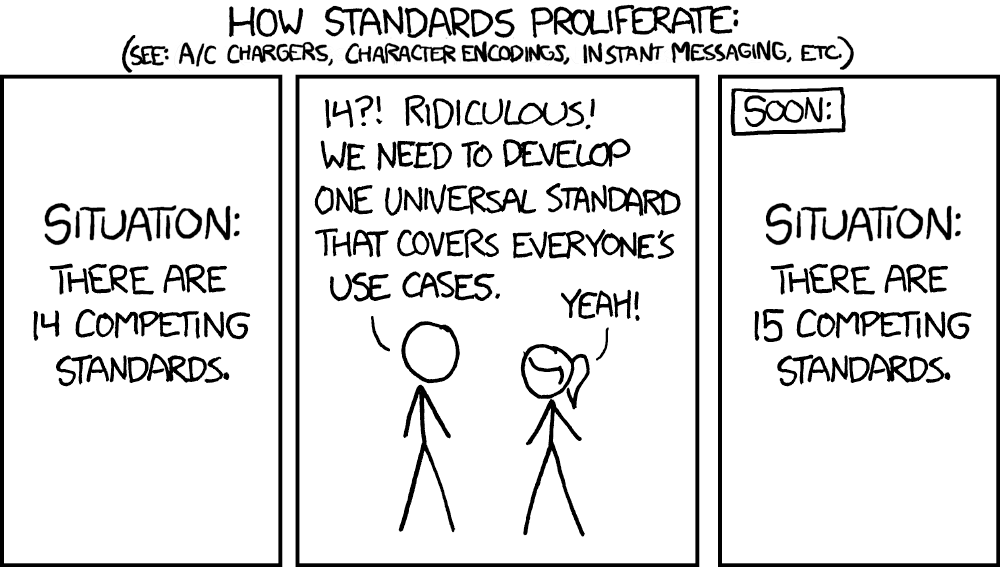
Well, there are a total of six standards that define JSON.
- RFC 4627 → RFC 7158 → RFC 7159 → RFC 8259 (IETF evolution)
- ECMA-404 (the “canonical” standard)
- ECMAScript (JavaScript’s take)
- JSON5, HJSON (supersets with “helpful” extensions)
Nicolas Seriot tested dozens of parsers against a comprehensive test suite and found that no two libraries exhibit the same behaviour. He wrote a blog post about it.
Edge cases and maliciously crafted payloads cause bugs, crashes, and denial of services — mainly because JSON libraries rely on specifications that evolved over time and left many details loosely specified or not specified at all.
Where the Spec Is Silent (or Shrugs) #
Four categories of deliberate ambiguity:
Duplicate Keys #
RFC 8259 says keys “SHOULD” be unique — not “MUST”. That single word choice creates a vulnerability class.
“When the names within an object are not unique, the behavior of software that receives such an object is unpredictable. Many implementations report the last name/value pair only. Other implementations report an error or fail to parse the object, and some implementations report all of the name/value pairs, including duplicates.” — RFC 8259
Three parsers, three outcomes:
- Parser A: first-key wins
- Parser B: last-key wins
- Parser C: throws error
Number Representation #
The spec explicitly punts on precision:
“This specification allows implementations to set limits on the range and precision of numbers accepted.” — RFC 8259
What’s “safe”? Integers in the range [-(2^53)+1, (2^53)-1]. Anything outside is implementation-defined.
Worse: Python’s json.dump will happily emit NaN and Infinity by default — values that aren’t valid JSON at all. Set allow_nan=False or your “JSON” will break compliant parsers.
Numbers like 1E400 or 3.141592653589793238462643383279 indicate potential interoperability problems — the producing software expects more precision than most consumers provide.
String Encoding #
String encoding was only explicitly required to be UTF-8 in the 2017 revision of the specification. Before that? Implementation-defined.
Handling of:
- Unpaired surrogates (
\uD800without a low surrogate) - NUL bytes in strings
- Escape sequence variations
…varies wildly across parsers.
Comments and Trailing Commas #
Not in any JSON spec. But JSON5 and HJSON accept them. Some “lenient” parsers in strict-mode languages accept them too.
Attackers can craft payloads that exploit inconsistent support for comments:
{ "qty": 1, "extra": 1 /*, "qty": -1, "extra2": 2*/ }Parser A (no comment support): syntax error
Parser B (comment support): {"qty": 1, "extra": 1}
Parser C (lenient): {"qty": -1} after stripping “comments”
Real Attack Scenarios #
BishopFox surveyed 49 JSON parsers and cataloged exploitable inconsistencies. Here are three attack patterns:
Key Collision Attacks (Duplicate Key Precedence) #
Scenario: Cart service validates, Payment service processes.
{ "qty": 1, "qty": -1 }- Cart service (Python, last-key precedence): sees
qty: -1, fails validation? No — JSON Schema validates the parsed object, which only has one key. - Payment service (Go, first-key precedence): sees
qty: 1
Result: attacker gets items, payment processes negative amount (refund).
Large Number Overflow #
{ "qty": 999999999999999999999999999999999999999999999999999999999999 }- Cart service (Python): faithfully decodes to Python’s arbitrary-precision int
- Payment service (Go with
buger/jsonparser): overflows, returns0
Result: qty validates as huge number, processes as zero cost.
Character Truncation #
Inject control characters to create “shadow keys”:
{ "qty": 1, "qty\u0000": -1 }Some parsers truncate at NUL byte, seeing two different keys. Others see one key with a NUL in its name. The mismatch creates exploitable gaps.
The Microservices Amplifier #
In a monolith, parser quirks are annoying. In microservices, they’re a vulnerability class.
“Parsers provided by standard libraries tended to be the most compliant, but they often lacked speed, which is of increasing importance in microservice architectures.” — BishopFox
Performance pressure drives teams to third-party parsers. Each service picks its own. Your validation layer uses Python’s json, your business logic uses Go’s encoding/json, your downstream uses Node’s JSON.parse — three different interpretations of the same payload.
┌─────────────┐    ┌─────────────┐    ┌─────────────┐
│   Gateway   │───▶│   Service   │───▶│  Database   │
│  (Python)   │    │    (Go)     │    │   (Node)    │
│ last-key    │    │ first-key   │    │ last-key    │
└─────────────┘    └─────────────┘    └─────────────┘
       │                 │                   │
       └── {"a":1,"a":2} sees a=2           │
                         └── sees a=1       │
└── sees a=2 againValidation passed at the gateway. Business logic saw different data. The vulnerability exists nowhere and everywhere.
Practical Mitigations #
-
Pick one parser, use it everywhere
- Reserialize at service boundaries
- Don’t pass raw JSON strings through validation layers
-
Reject duplicates explicitly
- Python: use
object_pairs_hookto detect duplicates - Most parsers can be configured to error on duplicate keys
- Python: use
-
Validate the parsed object, not just the schema
- JSON Schema validates structure, not parsing semantics
- Add explicit checks for edge cases
-
Use strict mode
- Python:
json.dumps(..., allow_nan=False) - Disable lenient parsing features
- Python:
-
Test with JSONTestSuite
- Seriot’s test corpus: https://github.com/nst/JSONTestSuite
- Run it against your stack’s parsers
- Document where they diverge
Closing Thought #
JSON’s simplicity is a mirage. The spec punts on hard decisions, and every library author made different choices. In a single-service world, this is an annoyance. In microservices, it’s a vulnerability class.
The fix isn’t to abandon JSON — it’s to stop assuming all parsers agree. They don’t. They never did.